
As solar power becomes more prevalent, its intermittent nature—generating only during the day with a peak at noon—presents a challenge for both users and the grid, which requires stable power supply. This is where the Energy Storage System (ESS), or more specifically, the Battery Energy Storage System (BESS), comes in as a crucial solution.
Think of BESS as a giant, intelligent “power bank.” It stores excess solar energy during peak generation hours and releases it when needed, effectively “shaving” the peak and “filling” the valleys of the solar production curve. This smooths out the power flow and unlocks multiple revenue streams, such as energy arbitrage (buying low, selling high) and providing grid services.
But how does this complex system actually work? It relies on the seamless coordination of several key components, each playing a vital role.
The Core Components of a Modern Energy Storage System
A safe and efficient BESS is much more than just batteries in a box. It is an integrated system where intelligent hardware and software work together.
1. The Brain: Energy Management System (EMS)
The EMS is the central intelligence hub. It monitors grid conditions, electricity prices, and user demand. Based on pre-set economic strategies (like peak-shaving), it sends automatic commands to charge or discharge the system, ensuring optimal financial and operational performance.
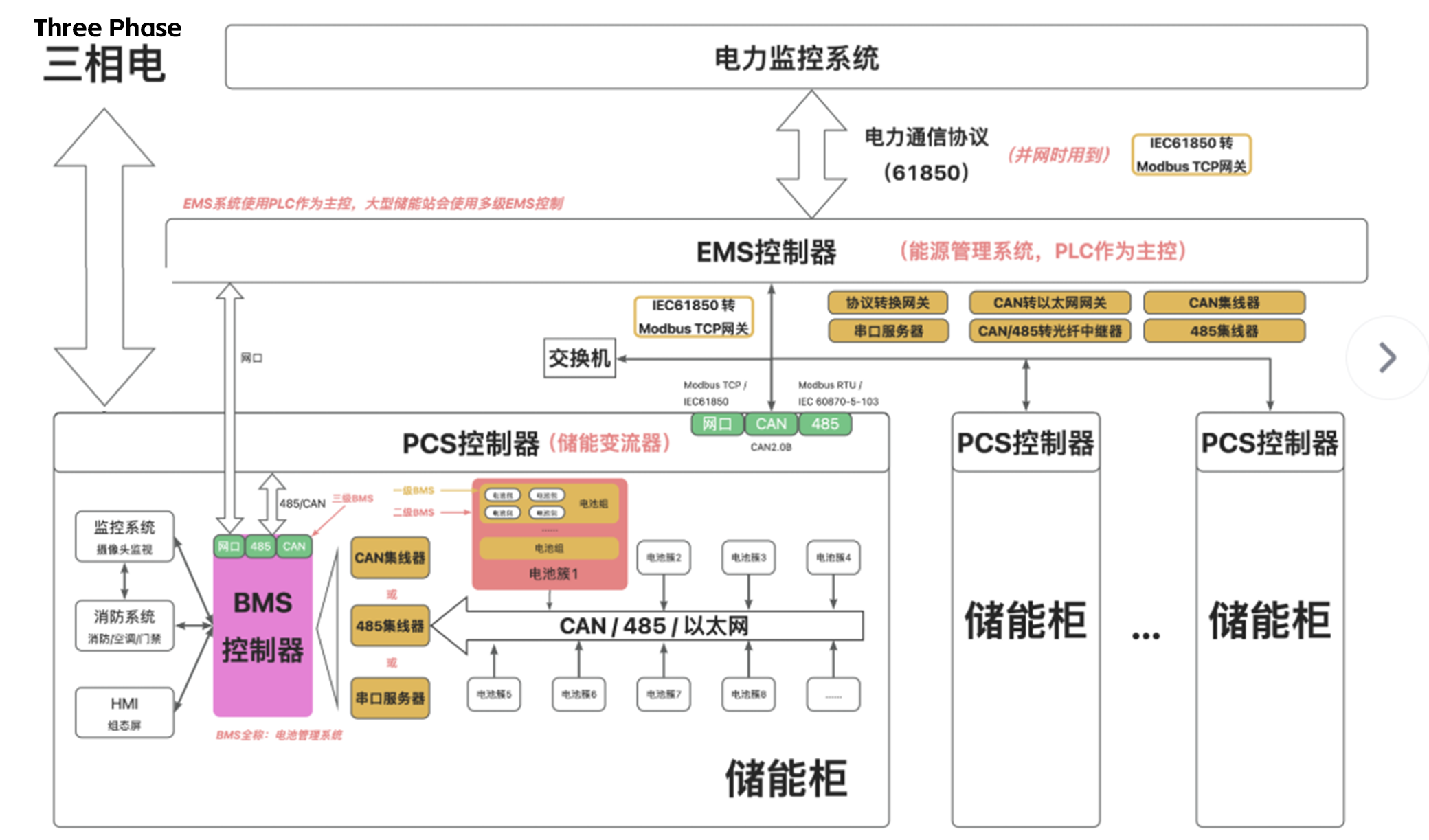
2. The Heart: Power Conversion System (PCS)
The PCS is the critical bi-directional converter. Unlike a solar inverter that only converts DC to AC, the PCS works both ways: converting AC power from the grid to DC for charging the batteries, and converting stored DC power from the batteries back to AC for discharge. It’s the essential gateway between the batteries and the power grid.
3. The Cells & Structure: Battery Pack and Rack
Batteries are organized hierarchically for efficient management. Individual cells are grouped into modules, then assembled into a Pack (a standardized battery block). Multiple Packs are then integrated into a larger Rack, which is the standard unit installed in a container.
4. The Guardian: Battery Management System (BMS)
The BMS is the vigilant guardian of battery health and safety. It constantly monitors every cell’s voltage, temperature, and state of charge (SOC) within a Pack or Rack. It ensures balance between cells, prevents dangerous conditions like overcharge or overheating, and communicates vital data to the EMS and PCS.
5. The Safety Shield: Thermal Management & Fire Suppression
Reliable operation requires strict temperature control. Systems use air-cooling or liquid-cooling to dissipate heat from the battery racks. Furthermore, a dedicated fire suppression system is installed inside the container as a last line of defense, ensuring safety is never compromised.
Conclusion: The Intelligent Backbone of the New Energy Era
A modern energy storage system is a sophisticated symphony of hardware and software. From the strategic EMS and versatile PCS to the meticulous BMS and robust safety systems, each component is essential for creating a safe, profitable, and grid-friendly asset.
Ready to explore how an energy storage system can optimize your energy usage and generate new revenue?
[Contact Chasun's experts today for a free consultation and system analysis].
Post time: Dec-09-2025