
In 1839, Edmund Becquerel discovered the photovoltaic effect, laying the foundation for solar technology. However, it was significant advancements, including the development of silicon solar cells (the core raw material for solar panels) in the 1950s, that paved the way for the widespread application of modern solar energy.
Since then, the cost of solar power generation has decreased, while photovoltaic panels have become more efficient, lighter in weight, and significantly improved in appearance. This has driven a surge in demand for solar energy. The global solar market is expected to experience significant growth between 2021 and 2029, with an anticipated increase of approximately 123% by 2029.
This article will provide a detailed explanation of the components that make up a solar panel.
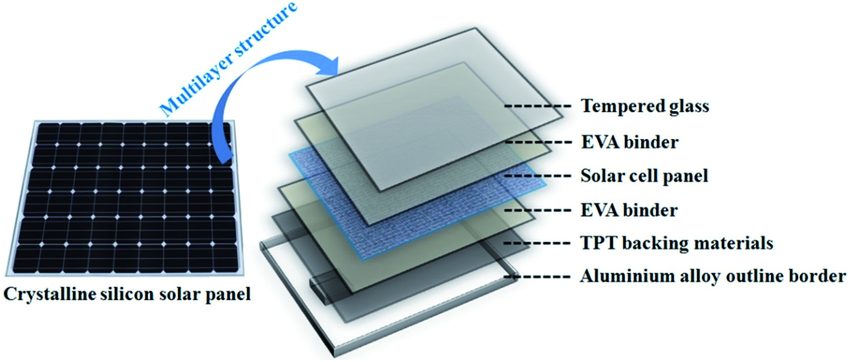
What is a Solar Photovoltaic Module and Its Components?
A solar module, also known as a photovoltaic (PV) module, is a device that converts sunlight into electricity and serves as a key component of a solar energy system.
Solar panels convert sunlight into direct current (DC) electricity. This DC power is then sent to an inverter, which converts it into alternating current (AC) electricity compatible with most household appliances and the power grid.
A photovoltaic module is composed of the following parts:
- Solar cells
- Busbars
- Encapsulant
- A backsheet
- A frame
- A glass
- A junction box
Solar Cells
Photovoltaic modules are the most crucial component of a solar energy system. Similarly, solar cells are the most vital parts within the PV module. They are responsible for capturing solar energy and converting it into usable electricity.
A solar module consists of multiple solar cells, typically 66 or 72, which are connected together via wiring. Solar cells are made from thin silicon wafers. Each cell is connected to others by thin conductive strips called busbars.
Solar cells are the most expensive part of a solar panel. The quality of a solar cell depends on its manufacturing material. Silicon cells are generally more expensive than thin-film cells. While silicon cells cost more, they are also more efficient. This is a primary reason why most solar panel manufacturers focus on silicon panels. Currently, 90% of the solar photovoltaic panels on the market are made of silicon.
Busbars
Busbars are thin conductive strips, usually made of copper or aluminum, used to collect and distribute the electrical current generated by individual solar cells within the module. They are positioned on the surface of the cells and interconnect them to form a circuit. The number of busbars depends on the cell design and desired efficiency. While increasing the number of busbars generally reduces electrical resistance and improves current collection efficiency, it may also slightly reduce the light-receiving surface area, potentially affecting overall power generation. Furthermore, new technologies such as multi-busbar cells and busbar-free designs are being explored to further optimize efficiency and address other issues.
Glass
Solar photovoltaic modules require protection from environmental factors like moisture, dust, and physical impact, while also ensuring that sunlight can reach the solar cells. This is where the glass comes in.
Modules do not use ordinary glass; solar cells are protected by tempered glass—which is 2 mm thick and up to six times stronger and more durable than regular glass.
The glass is also treated with an anti-reflective coating to reduce reflection and increase the amount of sunlight reaching the solar cells.
The main purpose of the solar panel glass is to transmit as much sunlight as possible into the module while ensuring high solar radiation transmittance and low reflectivity.
Backsheet
The backsheet is located on the rear side of the module. It is typically made of multiple layers of polymer materials, such as polyvinyl fluoride (PVF) or ethylene tetrafluoroethylene (ETFE). The backsheet also acts as an electrical insulator, helping to prevent electric shock and short circuits.
The primary function of the backsheet is to protect the solar cells and other internal components of the module from moisture, dust, and other environmental factors. This extends the module’s lifespan and ensures its performance remains stable over the long term.
The backsheet can also help reflect light back onto the solar cells, thereby improving the module’s efficiency.
Encapsulant (EVA)
The encapsulant is a thin layer of polymer material applied to both the front and back of the solar cells inside the module. It serves several key functions:
- Protection: It shields the cells from environmental factors like moisture, dust, and other external elements.
- Mechanical Support: It provides structural support to the cells, holding them in place and preventing physical damage or movement.
- Electrical Insulation: It helps electrically insulate the cells and other components within the module.
- Light Transmission: It is designed for optimal light transmittance, allowing the solar cells to absorb light fully while minimizing any potential absorption or blockage.
Frame
The frame of a solar module holds all the other components together and provides the module with its structure. It is usually made of aluminum or stainless steel and wraps around the module’s edges.
The frame also provides a convenient place for mounting the module and a way to secure other components.
Junction Box
The junction box is a small enclosure located on the back of the module that houses the electrical connections between the solar cells and the external circuit. It is typically made of plastic or metal and is designed to protect the electrical connections from moisture and dust.
The junction box connects the module to the rest of the solar power generation system.
Conclusion
From solar cells and busbars to the junction box and frame, each component plays an important role in the overall performance of the module.
High-quality materials are essential for producing high-quality solar panels. Substandard solar cells or busbars can increase the internal resistance of a solar module, causing it to overheat and potentially creating safety hazards.
Inferior encapsulant, backsheet, or frame materials are prone to wear and tear, leading to moisture infiltration into the module and damage to the solar cells. Failures in the junction box or connectors can also reduce the output power of the solar module.
Therefore, selecting a high-quality solar panel involves scrutinizing each of its component parts.
Choosing a trusted brand is an effective way to ensure the reliability of your solar panels. We are proud to distribute industry-leading brands, including Jinko Solar, LONGi Solar, JA Solar, and Trina Solar. Welcome to explore and select from our premium range!
Post time: Dec-16-2025