
In the past few years, the global photovoltaic (PV) industry has seen a noteworthy shift toward higher-efficiency solar modules. One of the key trends reshaping module selection and solar project value is the rising presence of products that exceed 22.5% conversion efficiency — a benchmark that increasingly defines premium commercial-grade panels.
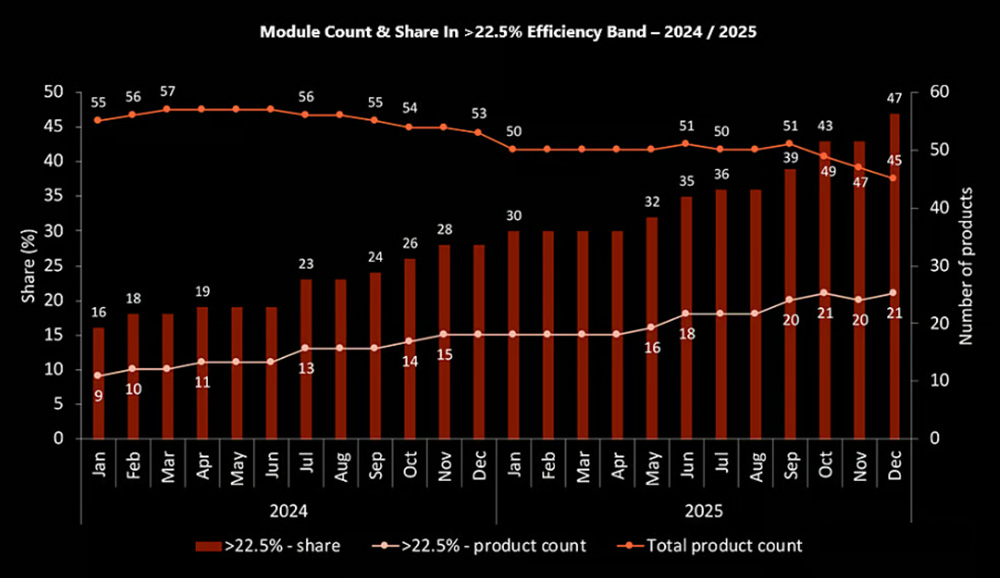
Efficiency Bands: What They Tell Us
Solar modules are often grouped into efficiency bands — ranges of power conversion performance that help industry analysts assess technological progress. Bands above 22.5% efficiency represent the fastest-advancing segment because they reflect the adoption of advanced cell technologies such as TOPCon (Tunnel Oxide Passivated Contact), BC (Back Contact) and, increasingly, HJT (Heterojunction).
Between early 2024 and the end of 2025, the number of modules in this top efficiency band has grown significantly. Products rated above 22.5% increased from a modest portion of the market to occupy nearly half of the premium PV segment in global module listings. This shift indicates both rapid innovation by manufacturers and market demand for higher energy yields.
Technology Advancements Driving Efficiency Growth
Several module makers have contributed to the expansion of the >22.5% efficiency band through internal upgrades and new product introductions. Many of these improvements are rooted in TOPCon technology — known for its excellent passivation and low recombination losses — as well as advanced BC cell structures and optimized manufacturing processes.
Over the course of 2025, leading brands continued to raise the efficiency ceilings of their highest-end modules. For example, TOPCon-based modules achieved new performance benchmarks through incremental improvements, while BC technology pushed commercial efficiency toward the mid-20% range.
This progress reflects a broader industry trend: solar developers and investors are prioritizing modules that deliver the highest possible energy output per unit area. In markets where land costs, installation labor, and balance-of-system considerations matter, each percentage point of efficiency can markedly impact project economics.
Impact on Solar Project Planning and ROI
For solar project developers, EPC firms, and system integrators, the shift toward >22.5% efficient modules has practical business implications:
-
Higher energy yield per panel — projects can achieve greater annual electricity production without increasing land footprint.
-
Improved bankability — panels above 22.5% are often preferred in competitive bidding and financing due to their measured performance.
-
Future-proof asset value — higher efficiency contributes to longer-term operational reliability and returns.
As efficiency thresholds rise industry-wide, manufacturers that consistently innovate and scale advanced technologies are more likely to gain global market share — while supporting utilities and commercial developers in achieving lower levelized costs of electricity (LCOE).
Why High-Efficiency Modules Matter Now
Today’s high-efficiency modules are not just theoretical improvements — they are commercially available products being deployed in live solar farms and distributed energy projects. Their growing representation in module listings signals a maturation of advanced cell technologies beyond niche experiment to standard practice for utility-scale and large-C&I applications.
One standout example of high-efficiency PV technology is the Tiger Neo 3.0 series, which leverages N-type TOPCon cell architecture and optimized module design to deliver excellent conversion performance, bifacial gain, and reliable low-light response — making it an ideal choice for projects targeting maximum energy yield and long-term return on investment.
→ Learn more about how Tiger Neo 3.0 high-efficiency modules can boost the performance of your solar installations on our product page at Chasun.
Post time: Jan-14-2026