
Residential Energy Storage Systems (Residential ESS) are becoming an essential part of modern home energy solutions.
They enable households to store solar energy, reduce electricity bills, and maintain power during grid outages.
This article explains how residential ESS works, how systems are sized, and why system design matters.
1. What Is a Residential Energy Storage System?
A residential ESS is a small-scale energy storage system designed for homes, typically paired with rooftop solar PV.
Its main objectives are:
-
Increase solar self-consumption
-
Reduce dependence on the grid
-
Provide backup power
2. Typical Home Solar + ESS Configuration
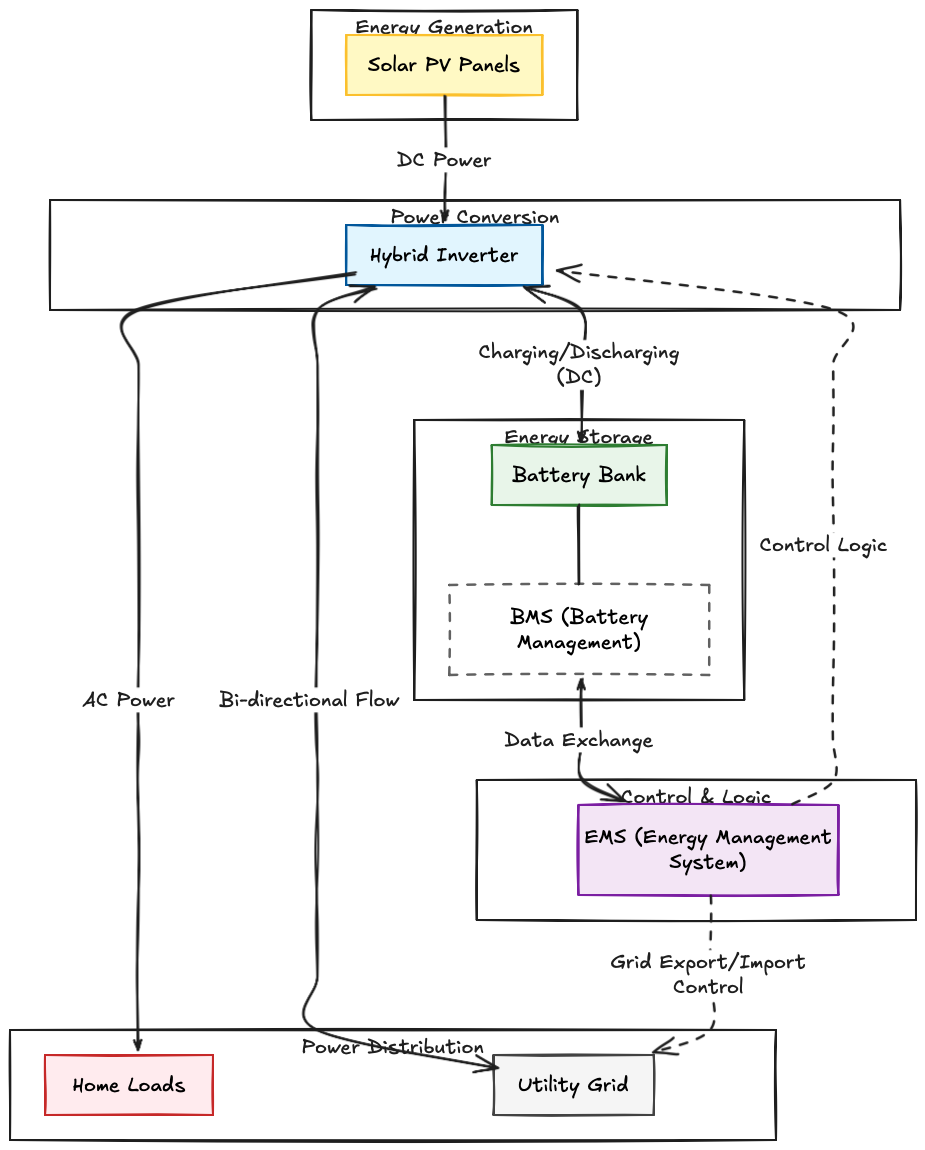
A standard residential solar + storage system includes:
-
Rooftop solar PV modules
-
Hybrid inverter or inverter + PCS
-
Battery storage system (LiFePO₄ preferred)
-
Home loads & grid connection
Diagram 1: Residential Solar + ESS System (Text Description)
3. How Residential ESS Works During a Typical Day
Daytime
-
Solar PV supplies home loads
-
Excess energy charges the battery
Evening / Night
-
Battery discharges to supply loads
-
Grid consumption is reduced
4. Sizing a Residential ESS: Basic Energy Calculation
Daily Household Energy Consumption
Daily Energy (kWh)=∑(Appliance Power (kW)×Usage Time (h))
Example:
-
Refrigerator: 0.2 kW × 24 h = 4.8 kWh
-
Lighting & appliances: 1.2 kW × 6 h = 7.2 kWh
Total daily consumption:
4.8+7.2=12 kWh
A residential ESS is typically sized to cover 50–100% of daily consumption, depending on budget and backup requirements.
5. Why PV Module Efficiency Is Critical for Home ESS
Rooftop space is limited.
High-efficiency solar modules allow homeowners to:
-
Generate more energy per square meter
-
Charge batteries faster
-
Improve system economics
This is why many residential systems choose high-efficiency N-type modules, such as Jinko Tiger Neo 3.0, especially in regions with high temperatures or limited roof area.
Recommended residential PV solutions:
Jinko Tiger Neo 3.0 Solar Modules
6. Safety & Battery Technology Considerations
Residential ESS prioritizes safety and long service life.
LiFePO₄ batteries are widely used due to:
-
High thermal stability
-
Long cycle life
-
Lower fire risk
Proper BMS control and certified system design are essential for safe home operation.
Conclusion
Residential energy storage systems enable homeowners to maximize solar value, improve energy independence, and enhance power security.
When paired with high-efficiency PV modules, residential ESS becomes a reliable and future-ready home energy solution.
Post time: Feb-06-2026