
Commercial and Industrial (C&I) Energy Storage Systems are increasingly adopted worldwide as electricity prices fluctuate, grid capacity becomes constrained, and renewable penetration continues to rise.
Unlike residential systems, C&I ESS is driven primarily by economic optimization and operational reliability.
1. What Is a C&I Energy Storage System?
A C&I Energy Storage System is designed to support:
-
Factories
-
Commercial buildings
-
Industrial parks
-
Logistics centers
Its core purpose is to optimize electricity costs, stabilize power supply, and maximize on-site solar utilization.
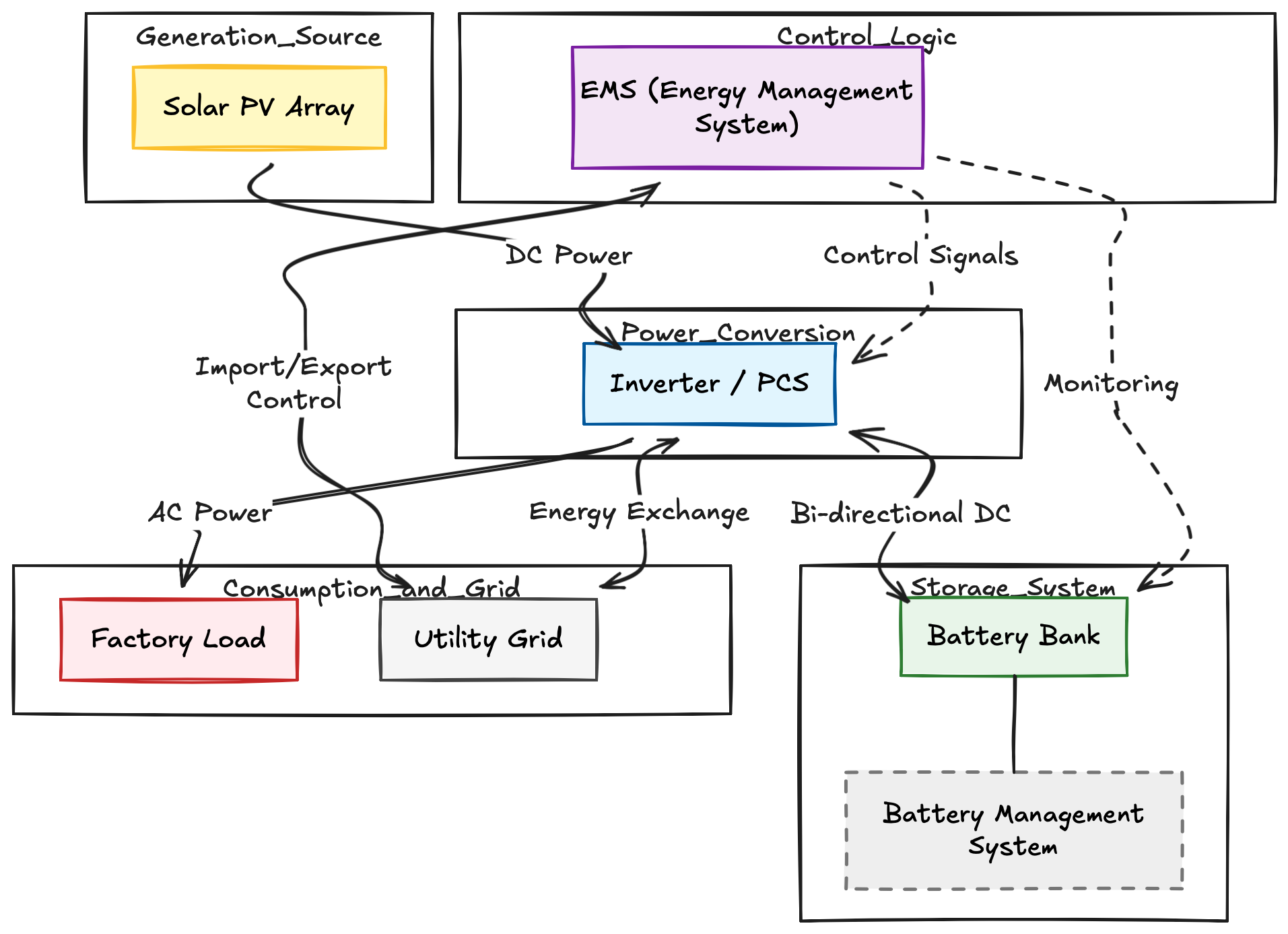
2. Typical C&I ESS System Architecture
A standard C&I ESS includes:
-
Solar PV system
-
Battery storage (LiFePO₄ commonly used)
-
PCS (bidirectional inverter)
-
EMS (energy management system)
-
Grid & load interface
Diagram 1: C&I Solar + ESS System Structure
3. Core Use Cases of C&I Energy Storage
① Peak Shaving & Valley Filling
C&I users store energy during low-tariff periods and discharge during peak-price hours.
Daily electricity cost saving formula:
Daily Savings=(Peak Tariff−Off-Peak Tariff)×Discharged Energy (kWh)
② Solar Self-Consumption Optimization
Solar + ESS increases the proportion of solar energy consumed on-site instead of exported to the grid.

Higher self-consumption directly improves project returns.
③ Backup Power & Grid Support
In regions with unstable grids, ESS ensures continuous operation during outages, protecting production continuity.
4. Why PV Efficiency Matters in C&I ESS Projects
Battery systems depend on surplus solar generation.
Higher-efficiency PV modules deliver:
-
Faster battery charging
-
Higher daily energy throughput
-
Better IRR for ESS projects
This is why C&I systems are often paired with high-efficiency N-type modules, such as Jinko Tiger Neo 3.0.
Recommended PV solutions for C&I projects:
Jinko Tiger Neo 3.0 Solar Modules
Jinko All-in-one C&I ESS 261kWh
5. Basic Economic Evaluation of C&I ESS
Simple Payback Period Formula

Where annual savings include:
-
Electricity bill reduction
-
Demand charge reduction
-
Increased solar self-consumption
In many emerging markets, payback periods range between 3–6 years, depending on tariff structure and system design.
Conclusion
C&I energy storage systems transform solar generation into a controllable and economically optimized energy asset.
When combined with high-efficiency PV modules like Jinko Tiger Neo 3.0, C&I ESS projects can achieve stronger financial returns and operational resilience.
Post time: Feb-05-2026