
China’s government has announced a major shift in export tax rebate policy for photovoltaic (PV) products and related components, a move that will have significant implications for the global solar supply chain.
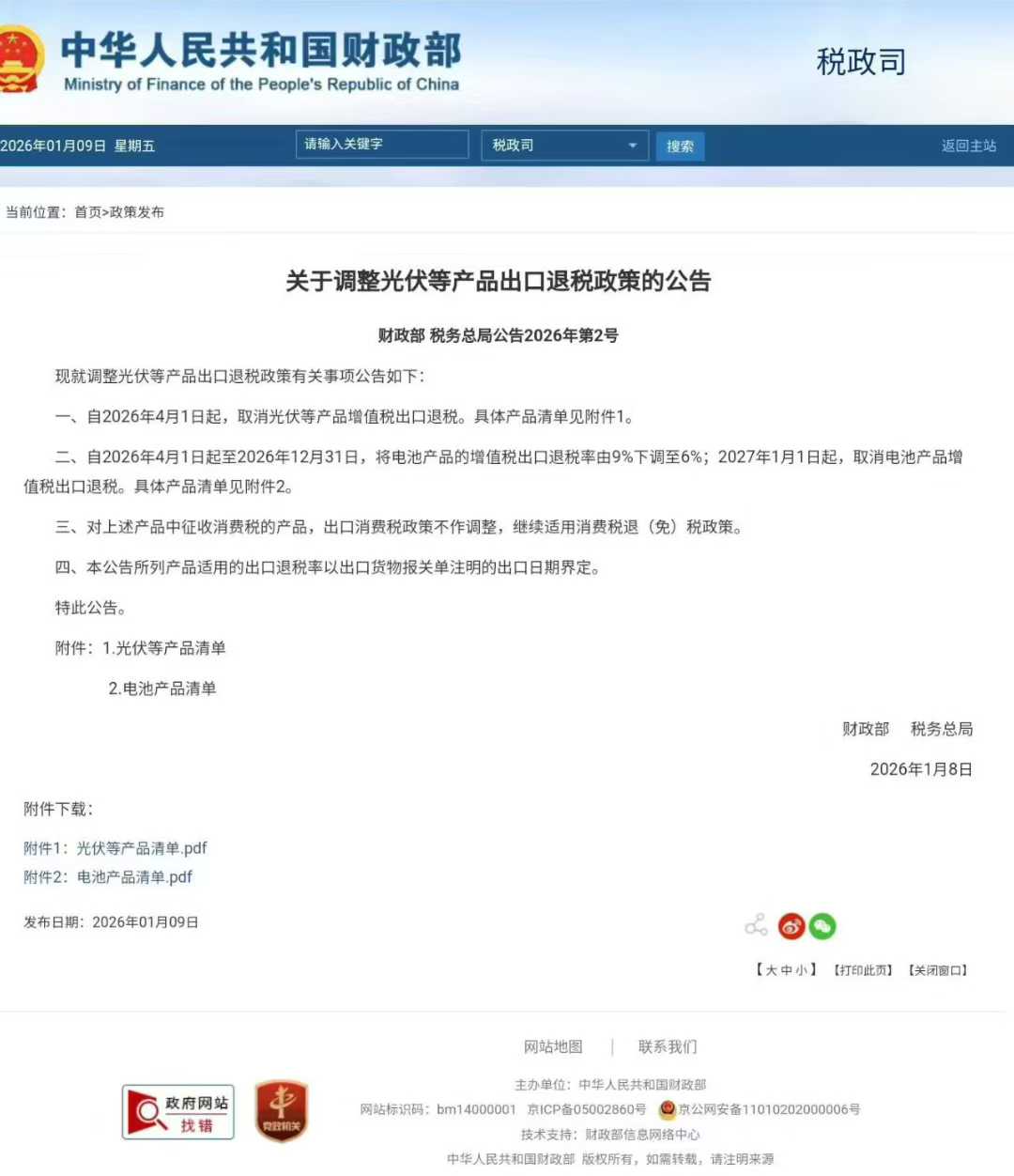
In a joint announcement by the Ministry of Finance and the State Taxation Administration, China confirmed that value-added tax (VAT) export rebates for PV products will be fully canceled starting April 1, 2026. This change affects all key photovoltaic export categories — including solar wafers, cells, modules, and other associated products — which have historically benefited from rebates designed to support export competitiveness. At the same time, export VAT rebates for battery products will be gradually reduced from 9% to 6% between April 1 and December 31, 2026, before being eliminated entirely on January 1, 2027.
Policy Background and Rationale
China’s export rebate system previously provided VAT refunds on a range of manufactured goods to help offset domestic value-added taxes for exporters. In the solar industry, this policy was widely used to support foreign market expansion and price competitiveness. However, as global PV products have increasingly faced price pressure, trade disputes, and oversupply concerns, policymakers opted to phase out these incentives.
The China Photovoltaic Industry Association has publicly welcomed the policy change, stating that removing export tax rebates can help restore rational pricing in overseas markets, reduce the risk of trade frictions, and align export prices more closely with actual production costs. By encouraging a more market-oriented export pricing mechanism, the policy aims to mitigate aggressive pricing that has at times triggered counterpart anti-dumping and countervailing actions in key importing regions.
Short-Term Market Impacts
In anticipation of the upcoming policy changes, industry analysts and market participants expect a rush of export activity before April 1, 2026, as buyers seek to secure shipments ahead of the rebate removal and potential cost increases. This front-loading behavior could temporarily support demand and put upward pressure on prices in the early months of 2026.
Moreover, the elimination of VAT export rebates means that Chinese solar module manufacturers may see higher net export costs, which could lead to adjustments in pricing strategies and negotiation dynamics with overseas buyers.
Long-Term Effects on the PV Industry
Over the long run, removing export rebates is likely to support a healthier competitive environment by prioritizing technological value and production efficiency over low-cost subsidies. The policy may accelerate industry consolidation, with less efficient manufacturers — particularly those that relied heavily on rebate-driven pricing — facing increasing cost pressures. Leading, well-capitalized producers with strong brand equity and advanced products are expected to be better positioned to maintain global market share as export incentives phase out.
At the same time, global buyers and project developers will increasingly evaluate PV modules not just on price, but on performance, reliability, bankability, and long-term value — factors that favor high-efficiency, Tier-1 products.
What This Means for Solar Project Buyers
For solar developers, EPC contractors, and system integrators planning projects in 2026 and beyond, this policy shift underscores the importance of forward procurement planning and supplier selection based on technical performance and supply stability rather than rebate-embedded pricing alone.
In USD terms, assuming an exchange rate of RMB 6.98, with a 9% rebate, the module will be priced at $0.0998/W. With zero rebate, the price will increase to $0.1092/W.
High-efficiency PV modules — such as JinkoSolar’s Tiger Neo 3.0 series — are designed to deliver superior conversion efficiency, enhanced bifacial performance, and strong low-light generation, making them highly suitable for both utility-scale and commercial deployments in a post-rebate market environment.
→ To explore high-efficiency solutions tailored for your solar projects, visit our Tiger Neo 3.0 product page at Chasun.
Post time: Jan-12-2026